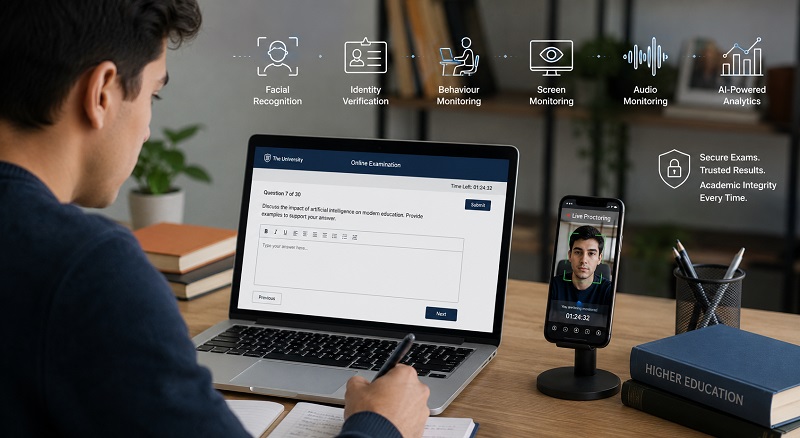
Artificial intelligence is transforming education at an unprecedented pace. Generative AI platforms such as ChatGPT, Google Gemini and Claude AI have become valuable learning tools for students and educators alike, providing instant explanations, assisting with research, generating practice questions and simplifying complex topics. These technologies are helping students learn more efficiently, but they are also introducing new challenges for educational institutions responsible for maintaining academic integrity.
As online learning and digital assessments become increasingly common, universities, colleges and training providers are re-evaluating how they protect examination integrity. Traditional methods of preventing cheating were developed before generative AI became widely accessible. Today, students can produce well-structured, original answers within seconds, making it much harder to determine whether submitted work genuinely reflects their own knowledge and understanding.
This shift does not mean artificial intelligence is inherently harmful to education. On the contrary, AI has enormous potential to improve teaching, personalise learning and increase student engagement. The challenge lies in ensuring that AI is used responsibly while preserving the credibility of qualifications and the fairness of assessments.
Modern online exam security therefore requires a more intelligent approach. Rather than focusing solely on the final answers students submit, institutions are increasingly monitoring the entire assessment process. AI-powered proctoring combines identity verification, behaviour analysis, screen monitoring and intelligent incident detection to help universities deliver secure, scalable and fair online examinations.
In this article, we explore how AI-generated answers are changing online assessment security, why traditional anti-cheating measures are no longer sufficient, and how AI-powered proctoring helps educational institutions adapt to the realities of digital learning in 2026.
Understanding AI-Generated Answers
Generative AI refers to advanced artificial intelligence systems capable of creating original content based on natural language prompts. Instead of simply searching existing websites, these platforms analyse vast amounts of information and generate new responses that closely resemble human writing.
Students can now ask AI tools to explain scientific theories, solve mathematical equations, write essays, generate computer code or summarise research papers in just a few seconds. The responses are often coherent, grammatically accurate and tailored to the specific question being asked.
For educational institutions, this creates a significant challenge because AI-generated answers may not resemble traditional plagiarism. Instead, they often appear as original work that cannot easily be matched to existing sources.
Why Students Are Using Generative AI
Students are adopting AI tools for a wide variety of reasons. Many use them responsibly to support learning, improve understanding and prepare for assessments. Others may be tempted to use them during examinations or coursework where independent work is expected.
Some of the most common educational uses include:
- Explaining difficult concepts in simple language.
- Generating study notes and revision material.
- Practising essay writing.
- Creating programming examples.
- Checking grammar and improving writing quality.
- Generating sample questions for revision.
- Researching unfamiliar topics more efficiently.
These applications can provide genuine educational value. However, when AI tools are used during examinations without authorisation, they can undermine the purpose of assessing a student’s own knowledge, analytical thinking and problem-solving abilities.
How AI-Generated Answers Differ from Traditional Plagiarism
For many years, plagiarism detection software has played an essential role in protecting academic integrity. These systems compare submitted assignments against published articles, books, journals, websites and previous student submissions to identify copied content.
Generative AI changes this landscape considerably. Rather than copying existing material, AI creates entirely new text based on the user’s instructions. Two students asking exactly the same question may receive different responses, making traditional plagiarism detection far less effective in identifying AI-assisted work.
This distinction is important because institutions can no longer rely solely on plagiarism reports when evaluating academic misconduct. Instead, they must consider how an assessment was completed, not just the content that was submitted.
| Traditional Plagiarism | AI-Generated Answers |
| Copies existing published material. | Produces original content in real time. |
| Usually detected through similarity checking. | May bypass traditional plagiarism software. |
| Matches online sources or previous submissions. | Creates unique wording for each prompt. |
| Evidence is based on copied text. | Requires behavioural evidence and monitoring. |
Why Detecting AI-Assisted Cheating Is Becoming More Difficult
Generative AI models continue to improve rapidly. Today’s systems can produce detailed academic responses, adapt their writing style to different educational levels and even explain complex reasoning processes. As these models become more sophisticated, distinguishing between human-written and AI-assisted content becomes increasingly difficult.
Students can also refine prompts multiple times until they receive an answer that closely aligns with the examination question. The final response may appear entirely original, contain no copied material and demonstrate an appropriate academic writing style, making it difficult for lecturers to identify potential misuse through manual review alone.
Specialised AI detection tools have emerged to address this challenge, but they are not always reliable. Most providers acknowledge that AI detection should not be treated as conclusive evidence because false positives and false negatives remain possible. Legitimate student work may occasionally be flagged incorrectly, while sophisticated AI-generated content may go undetected.
For this reason, educational institutions are increasingly adopting a broader approach to AI exam security. Rather than relying solely on written submissions, they are evaluating the complete assessment process by combining technology, institutional policies and human review.
The Growing Importance of Academic Integrity
Academic integrity has always been fundamental to education. Students, employers and professional bodies rely on examination results to demonstrate genuine knowledge and competence. When assessment standards are compromised, the value of qualifications and public confidence in educational institutions can be affected.
Generative AI does not eliminate the importance of academic integrity; instead, it reinforces the need for modern assessment strategies. Universities are increasingly recognising that secure online assessments require multiple layers of protection, combining responsible AI policies with technologies that verify student identity, monitor examination behaviour and provide evidence-based review processes.
In 2026 and beyond, maintaining examination integrity is no longer simply about preventing plagiarism. It is about ensuring that every assessment accurately reflects the student’s own abilities while allowing educational institutions to embrace the positive opportunities that artificial intelligence brings to teaching and learning.
Why Traditional Exam Security Is No Longer Enough
For many years, educational institutions relied on a combination of manual invigilation, plagiarism detection software and basic technical controls to protect the integrity of examinations. These methods continue to play an important role, but the rapid advancement of generative AI has highlighted their limitations. Modern online assessments require a more comprehensive approach that considers not only what students submit but also how they complete an assessment.
Artificial intelligence has fundamentally changed the assessment landscape. Students no longer need to search websites for answers or copy existing material. Instead, they can generate original responses, solve complex problems and receive detailed explanations almost instantly. As a result, institutions must evolve their online exam security strategies to keep pace with these new technologies.
Manual Invigilation Has Practical Limitations
Human invigilators remain essential for maintaining examination standards, particularly for high-stakes assessments. However, monitoring hundreds or even thousands of students remotely presents significant operational challenges.
Unlike traditional examination halls where invigilators can observe physical behaviour directly, remote exams require monitoring through webcams and digital platforms. Even experienced invigilators may struggle to detect subtle behaviours such as repeated glances towards another device, quiet conversations or brief periods of unauthorised activity.
As online learning continues to grow, institutions require scalable solutions that support human reviewers rather than expecting them to monitor every student continuously.
Plagiarism Detection Alone Is No Longer Sufficient
Plagiarism detection software has become a standard tool across higher education. It remains highly effective for identifying copied material from books, academic journals, websites and previous student submissions.
However, AI-generated answers introduce an entirely different challenge. Because generative AI creates original wording for each response, there may be little or no similarity between the submitted work and existing online sources. This means plagiarism reports alone cannot reliably identify every instance of AI-assisted cheating.
Rather than replacing plagiarism detection, institutions should view it as one layer within a broader academic integrity strategy that also includes behavioural monitoring, identity verification and examination review.
Browser Restrictions Have Their Limits
Many universities use lockdown browsers to restrict student activity during online assessments. These tools can prevent students from opening additional browser tabs, copying and pasting content or accessing unauthorised websites from the examination device.
Although valuable, browser restrictions cannot eliminate every risk. Students may still access AI tools using a second smartphone, tablet or laptop positioned outside the monitored screen. Others may use wearable devices, smart assistants or external communication platforms that operate independently of the examination browser.
For this reason, browser restrictions should be combined with additional monitoring technologies rather than relied upon as a standalone security measure.
Identity Verification Must Continue Throughout the Assessment
Authenticating a student’s identity before an examination begins is an important first step, but maintaining examination integrity requires continuous verification throughout the assessment.
A verified student could still receive assistance from another individual, temporarily leave the examination environment or use unauthorised resources after the assessment has started. Continuous monitoring helps institutions identify these situations while providing evidence for fair and informed review.
New AI Cheating Methods Educational Institutions Face
As generative AI becomes increasingly accessible, educational institutions are encountering new forms of academic misconduct that extend beyond traditional plagiarism. Understanding these risks is essential when designing secure digital assessments.
AI-Assisted Answer Generation
The most obvious challenge is the ability to submit examination questions directly into AI platforms such as ChatGPT, Google Gemini or Claude AI. Within seconds, students can receive detailed explanations, essays, calculations or programming code that appears original and academically sound.
Because these responses are generated in real time, they often avoid traditional plagiarism detection while still providing students with an unfair advantage.
Using Hidden Secondary Devices
Even when an examination computer is secured, students may attempt to use additional devices positioned outside the primary camera view. Smartphones, tablets or secondary laptops can provide discreet access to AI tools, messaging applications or online resources throughout an assessment.
This makes behavioural monitoring increasingly important, as unusual eye movements or repeated attention towards another location may indicate the presence of unauthorised devices.
Voice-Based AI Assistance
Many modern AI platforms now support voice interaction. Students can ask spoken questions and receive verbal responses through smart assistants or AI applications, potentially using wireless earbuds or discreet audio devices.
This creates challenges that traditional plagiarism detection cannot address because no written evidence of AI usage may exist within the submitted assessment.
Remote Collaboration During Online Assessments
Digital communication platforms make it easier than ever for students to collaborate in real time. Messaging applications, shared documents, video conferencing tools and AI-assisted chat platforms may all be used to exchange information during an assessment if appropriate safeguards are not in place.
Remote collaboration is particularly difficult to identify through submitted answers alone, reinforcing the importance of comprehensive online exam security.
Switching Between Applications
Some students attempt to bypass examination restrictions by switching between applications, using virtual desktops or connecting to cloud-based environments that provide access to external resources.
These activities may only last a few seconds, making them difficult for manual invigilators to detect without technological assistance.
Why Behaviour Matters More Than Ever
Perhaps the most significant change in examination security is the growing importance of behavioural evidence. While written responses remain valuable, they no longer tell the complete story.
Modern AI exam security focuses on understanding how an assessment was completed. Behaviour analysis, identity verification, screen monitoring and intelligent incident detection provide institutions with a broader view of student activity, enabling more informed decisions when reviewing potential academic misconduct.
| Traditional Online Cheating | AI-Assisted Cheating | Recommended Security Measure |
| Copying published content | Generating original AI responses | Plagiarism detection plus AI proctoring |
| Searching websites | Using ChatGPT or Gemini during exams | Screen and browser monitoring |
| Receiving written notes | Using secondary devices | Behaviour analysis and video monitoring |
| Receiving help from another person | Voice-based AI assistance | Audio monitoring and identity verification |
| Impersonation | Proxy test-taking with AI support | Facial recognition and continuous authentication |
As educational institutions continue embracing digital learning, protecting examination integrity requires more than identifying copied content. The future of secure online assessments depends on combining intelligent technology, institutional policies and human judgement to create a fair environment for every student.
How AI Proctoring Improves Exam Security
As online assessments become more sophisticated, educational institutions need security solutions that go beyond simply reviewing submitted answers. AI proctoring provides a comprehensive approach by combining artificial intelligence with human oversight to monitor the entire assessment process. Rather than replacing academic staff, AI supports examination teams by automatically identifying potential incidents that require further review.
Modern AI-powered proctoring platforms analyse multiple sources of information simultaneously, including student identity, behaviour, screen activity and environmental factors. This multi-layered approach enables institutions to deliver secure online exams while maintaining a positive experience for genuine students.
Facial Recognition for Student Authentication
Facial recognition technology helps verify that the registered student is the individual completing the assessment. Before an exam begins, the system compares the student’s live image with an existing profile photograph or institutional identity record.
Some AI proctoring platforms perform additional facial verification checks during the examination to ensure that the same person remains present throughout the session. This significantly reduces the risk of impersonation and proxy test-taking.
Continuous Identity Verification
Authentication should not end once a student logs into an assessment. Continuous identity verification provides an additional layer of protection by monitoring whether the authorised student remains present for the duration of the examination.
Combined with secure login procedures and learning management system (LMS) integration, continuous authentication strengthens examination integrity without creating unnecessary disruption for legitimate candidates.
Behaviour Analysis and Intelligent Monitoring
Behaviour analysis has become one of the most valuable features of AI exam security. Instead of focusing solely on submitted answers, artificial intelligence evaluates behavioural patterns that may indicate unusual activity.
Examples include:
- Repeatedly looking away from the screen.
- Leaving the examination area.
- Multiple people appearing within camera view.
- Frequent movement suggesting access to external resources.
- Covering or obstructing the webcam.
- Unexpected interruptions during the assessment.
These observations do not automatically indicate misconduct. Instead, they provide contextual evidence that helps lecturers and examination officers review assessments fairly and consistently.
Screen Monitoring
Screen monitoring enables institutions to observe activity occurring on the examination device. Depending on institutional requirements, this may include screenshots, browser activity or application monitoring to identify attempts to access unauthorised websites, AI tools or external documents.
This capability is particularly valuable as students increasingly rely on multiple digital resources while completing online assessments.
Audio Monitoring
Audio monitoring complements video analysis by detecting unusual sounds that may suggest external assistance. Conversations, voices from other individuals or unexpected background activity can all be flagged for review.
Rather than continuously analysing every recording manually, AI highlights relevant incidents, allowing examination staff to focus on situations that genuinely require investigation.
AI-Powered Incident Detection
Artificial intelligence enables proctoring systems to analyse large volumes of examination data in real time. Instead of requiring staff to review hours of recorded video, AI identifies events that fall outside normal behavioural patterns.
This significantly improves operational efficiency while ensuring that examinations involving thousands of students remain manageable for academic teams.
GPS Verification Where Appropriate
Some institutions choose to verify the student’s examination location, particularly for remote or off-campus assessments. GPS verification can help confirm that students are completing assessments from approved locations and may identify unusual situations where multiple candidates appear to be taking the same examination from the same place.
Location verification should always be implemented in accordance with institutional policies and applicable privacy regulations.
AI Proctoring vs AI-Generated Cheating
The rapid advancement of generative AI has shifted the focus of examination security from analysing submitted work to understanding the assessment process itself. Behavioural evidence, continuous monitoring and intelligent verification provide a much stronger indication of academic integrity than written content alone.
| AI-Assisted Cheating Method | How AI Proctoring Responds |
| Using ChatGPT or similar AI platforms | Screen monitoring identifies unauthorised applications and browser activity. |
| Using a secondary smartphone or tablet | Behaviour analysis detects repeated attention towards external devices. |
| Receiving spoken assistance | Audio monitoring highlights unexpected conversations and voices. |
| Proxy test-taking | Facial recognition and continuous identity verification confirm the authorised student remains present. |
| Leaving the assessment area repeatedly | Behaviour monitoring records unusual movement and prolonged absences. |
| Collaborating remotely with others | Combined behavioural, audio and video evidence supports post-exam review. |
This layered approach enables universities to investigate potential misconduct based on multiple sources of evidence rather than relying solely on plagiarism reports or AI detection tools.
Building a Multi-Layered Online Exam Security Strategy
No single technology can eliminate every form of academic misconduct. The most effective online exam security strategies combine intelligent technology, institutional policies and experienced academic oversight.
Educational institutions should consider implementing:
- Secure student authentication before every assessment.
- Continuous identity verification throughout examinations.
- AI-powered behaviour analysis.
- Screen and browser monitoring.
- Audio monitoring where appropriate.
- Learning management system integration.
- Clear academic integrity policies.
- Regular staff and student awareness programmes.
When these measures work together, institutions create a fair assessment environment that protects genuine students while reducing opportunities for academic misconduct.
In the next section, we explore the practical steps universities can take to prepare for AI-assisted education, strengthen examination integrity and build greater confidence in digital assessments.
Best Practices for Universities in 2026
Artificial intelligence is now a permanent part of higher education. Rather than attempting to eliminate AI from education entirely, institutions should develop assessment strategies that encourage responsible use while protecting academic integrity. Universities that combine clear policies, thoughtful assessment design and modern AI-powered exam security will be better positioned to maintain confidence in their qualifications.
The following best practices can help institutions adapt to the evolving assessment landscape while creating a fair experience for both students and educators.
Design Assessments That Measure Critical Thinking
Traditional examinations often focus on recalling information, making them more vulnerable to AI-generated responses. Modern assessments should encourage students to analyse, evaluate, justify and apply knowledge to real-world scenarios.
Examples include:
- Case studies requiring critical analysis.
- Scenario-based problem solving.
- Reflective responses supported by personal reasoning.
- Practical demonstrations of skills.
- Oral presentations or viva examinations.
These assessment formats make it significantly more difficult for students to rely solely on generative AI.
Develop AI-Aware Assessment Policies
Educational institutions should establish clear guidelines explaining when artificial intelligence may and may not be used. Students should understand whether AI is permitted for research, drafting, revision or proofreading and when independent work is required.
Transparent policies reduce confusion while encouraging students to use AI responsibly instead of attempting to hide its use.
Use Multi-Layered Exam Security
No single security measure can address every form of academic misconduct. The most effective online assessments combine several complementary technologies.
A comprehensive AI exam security strategy may include:
- Student authentication before examinations.
- Facial recognition.
- Continuous identity verification.
- Behaviour analysis.
- Screen monitoring.
- Browser monitoring.
- Audio monitoring.
- AI-powered incident detection.
- Learning Management System (LMS) integration.
Each layer contributes additional evidence, allowing institutions to make fair and informed decisions when reviewing assessments.
Educate Students About Responsible AI Use
Many students genuinely want to use artificial intelligence ethically but remain uncertain about institutional expectations. Universities should provide guidance explaining acceptable AI use, academic honesty requirements and the consequences of misusing AI during assessments.
Building awareness is often more effective than relying solely on disciplinary action after misconduct has occurred.
Choose Secure Assessment Platforms
When selecting online assessment software, institutions should evaluate far more than individual features. Scalability, security, accessibility, technical support, privacy compliance and integration capabilities all contribute to long-term success.
A modern AI-powered proctoring platform should integrate seamlessly with existing learning management systems while providing reliable monitoring and efficient review tools for examination staff.
Benefits of AI-Powered Exam Security
When implemented responsibly, AI-powered proctoring provides significant advantages for universities, colleges, schools and professional training providers. Rather than replacing educators, it supports academic staff by automating routine monitoring tasks while allowing human reviewers to make final decisions.
- Strengthens academic integrity across online assessments.
- Creates a fair examination environment for every student.
- Reduces manual invigilation workload.
- Improves confidence in examination outcomes.
- Supports large-scale remote and hybrid assessments.
- Provides evidence-based incident reviews.
- Enhances operational efficiency for examination teams.
- Integrates with existing Learning Management Systems.
- Supports secure digital transformation across higher education.
Institutions also benefit from greater flexibility. Whether assessments are delivered on campus, remotely or through hybrid learning models, AI-powered proctoring helps maintain consistent security standards while accommodating growing student populations.
The Future of Online Exam Security
Artificial intelligence will continue to influence education in ways that extend far beyond assessment security. As generative AI becomes increasingly capable, universities will continue refining how they design assessments, evaluate student performance and protect qualification standards.
The future is unlikely to involve banning AI altogether. Instead, successful institutions will embrace AI as a valuable educational resource while implementing intelligent safeguards that ensure assessments continue measuring genuine knowledge, critical thinking and independent problem-solving.
AI-powered proctoring, combined with thoughtful assessment design and transparent academic policies, provides a practical path forward for institutions seeking to balance innovation with examination integrity.
Conclusion
Generative AI tools such as ChatGPT, Google Gemini and Claude AI have permanently changed the educational landscape. While these technologies offer enormous opportunities to improve learning and student engagement, they also challenge long-established approaches to online assessment security.
Traditional plagiarism detection, manual invigilation and browser restrictions remain valuable components of examination security, but they are no longer sufficient on their own. Modern institutions require a broader strategy that combines student authentication, behaviour analysis, screen monitoring, AI-powered incident detection and human oversight.
By adopting intelligent, multi-layered online exam security, universities and training providers can protect academic integrity while continuing to embrace innovation in teaching and learning. The objective is not to prevent the responsible use of AI but to ensure that formal assessments continue to reflect each student’s own abilities, knowledge and achievements.
Secure Your Online Assessments with The Invigilator
As online education continues to evolve, educational institutions need assessment solutions that are secure, scalable and designed for the realities of modern learning. The Invigilator provides AI-powered remote invigilation that helps universities, colleges, schools and training providers maintain academic integrity through intelligent identity verification, behaviour monitoring and comprehensive exam security.
If your institution is preparing for the future of digital assessments, contact The Invigilator today to discover how our AI-powered remote invigilation platform can help you deliver secure, accessible and trustworthy online examinations with confidence.
Frequently Asked Questions
1. What are AI-generated answers?
AI-generated answers are responses created by artificial intelligence tools such as ChatGPT, Google Gemini and Claude AI. These tools generate original text, solve problems and explain concepts based on user prompts, making them useful for learning but also challenging for maintaining academic integrity during assessments.
2. Why are AI-generated answers a challenge for universities?
Unlike traditional plagiarism, AI-generated answers are often unique and do not directly copy existing sources. This makes them more difficult to detect using conventional plagiarism detection software, requiring institutions to adopt more advanced online exam security measures.
3. How does AI proctoring help prevent cheating?
AI proctoring monitors the assessment environment using technologies such as facial recognition, identity verification, behaviour analysis, screen monitoring and audio monitoring. It identifies unusual activities and flags potential incidents for review by educators.
4. Can AI proctoring detect the use of ChatGPT during an exam?
AI proctoring does not identify AI-generated text directly. Instead, it monitors student behaviour, screen activity and browser usage to detect potential access to unauthorised AI tools during an assessment, depending on the institution’s exam settings and policies.
5. Is AI proctoring better than plagiarism detection software?
Both technologies serve different purposes. Plagiarism detection identifies copied content, while AI proctoring monitors the examination process itself. Using both together provides a stronger and more comprehensive approach to protecting academic integrity.
6. Does AI proctoring replace human invigilators?
No. AI proctoring supports human invigilators by automating routine monitoring and highlighting potential incidents. Final decisions regarding academic misconduct remain the responsibility of authorised examination staff.
7. What features should educational institutions look for in AI exam security software?
Institutions should consider features such as facial recognition, continuous identity verification, behaviour analysis, screen monitoring, audio monitoring, LMS integration, detailed reporting, scalability, privacy compliance and reliable technical support.
8. How can universities prepare for AI-assisted assessments?
Universities should combine AI-aware assessment policies, secure online assessment platforms, multi-layered exam security, student education and assessment designs that encourage critical thinking rather than simple information recall.