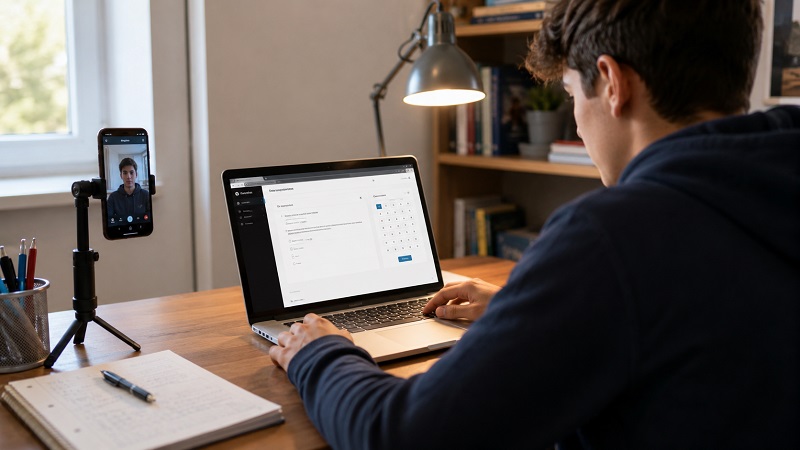
Online learning has transformed education across the globe and with it the way examinations are conducted has changed. Students are no longer confined to physical classrooms or exam halls. Instead, they can now take assessments online from their homes, libraries, or even remote rural areas. While this flexibility opens opportunities for students, it also raises questions about fairness, authenticity, and exam security. This is where AI proctoring comes into play.
AI powered proctoring provides institutions with a solution that maintains integrity during online exams while allowing students to participate from anywhere. With advanced monitoring, identity checks, and behaviour analysis, AI proctoring ensures assessments remain credible and trustworthy. In this article, we explore how AI is transforming exam supervision, the benefits it provides to both students and institutions, and why trust is a critical factor in the success of online education.
Understanding AI Proctoring
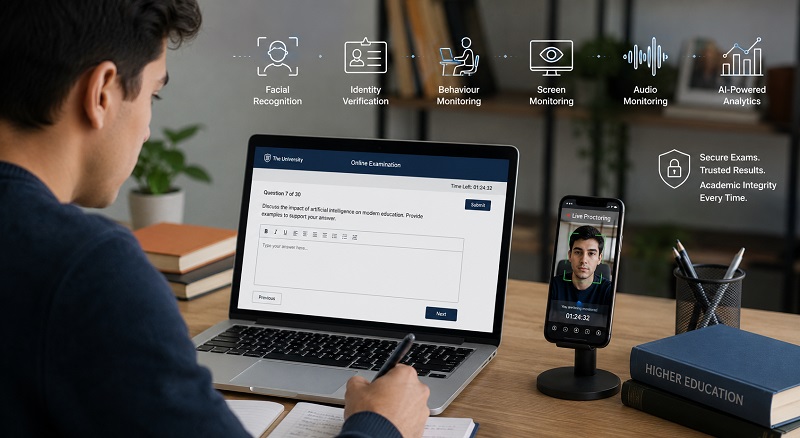
AI proctoring refers to the use of artificial intelligence technology to monitor students during online exams. Unlike traditional invigilators who are physically present in the exam hall, AI powered proctoring tools operate digitally, using cameras, microphones, and data analysis to detect suspicious activity.
The system may include:
- Facial recognition to confirm student identity.
- Video monitoring that analyses head movement, eye contact, and body position.
- Audio monitoring that picks up conversations or background noise.
- Screen monitoring that identifies attempts to use unauthorised websites, applications, or documents.
Through these technologies, institutions achieve a level of exam security that can even surpass human supervision.
Why Exam Security Matters
Exam security is essential because assessments are more than just a formality. They are benchmarks of student knowledge and ability. Employers, universities, and professional bodies depend on the accuracy of exam results when making decisions about candidates. If the credibility of an assessment system is compromised, then the entire value chain of education and professional recruitment suffers.
For example:
- A university degree loses credibility if students can easily cheat in online exams.
- A professional certification becomes meaningless if candidates bypass requirements with dishonest methods.
- Institutions risk reputational damage when their assessment processes are questioned.
AI proctoring acts as a safeguard against these risks.
How AI Proctoring Builds Trust
Trust is the foundation of any education system. Both students and institutions must believe that results are fair and accurate. AI proctoring enhances trust in several ways:
- Transparency
Students are aware that their activities will be monitored in a fair and consistent manner. - Consistency
AI removes bias or human error from the monitoring process. Every student is judged equally. - Accountability
Recordings of exams are stored and can be reviewed later to resolve disputes. - Fairness
Honest students are protected from unfair advantages gained by dishonest peers.
By strengthening these factors, AI proctoring creates an environment where online exams are seen as credible.
Key Features of AI Proctoring
- Identity Verification
The system ensures that the person sitting the exam is the enrolled student through facial recognition or ID scans. - Live Monitoring and Recording
Continuous tracking ensures the exam session is secure. AI flags suspicious behaviour instantly. - Behaviour Analysis
Movements such as looking away repeatedly, whispering, or leaving the screen are analysed for irregularities. - Plagiarism Detection
Integration with plagiarism tools ensures written responses are original. - Low Data Use
Many systems are optimised for students with limited internet access, making exam security inclusive. - Scalability
Institutions can run hundreds or thousands of online exams simultaneously without compromising quality.
Benefits for Students
- Fairness: Everyone is subject to the same rules.
- Accessibility: Students can take exams from anywhere without needing to travel to venues.
- Flexibility: Exam schedules are more adaptable.
- Confidence: Honest students know that their hard work is being recognised.
Benefits for Institutions
- Cost Saving: Reduced need for physical venues and invigilators.
- Efficiency: Automated reports summarise student behaviour.
- Reputation: Trustworthy assessments improve the institution’s credibility.
- Global Reach: Institutions can admit students internationally without worrying about exam logistics.
Challenges and Considerations
While AI proctoring offers significant advantages, there are challenges that need to be addressed.
- Privacy Concerns: Students may be uncomfortable with monitoring technology. Institutions should have clear policies and transparent communication.
- Technical Issues: Poor connectivity can disrupt exams, though many platforms have offline features.
- Adaptation: Both students and lecturers need guidance to understand how AI proctoring works.
Overcoming these challenges involves proper training, user-friendly platforms, and responsive support systems.
The Future of AI Proctoring
AI technology continues to evolve. Future systems may include advanced voice recognition, improved fraud detection, and integration with learning management systems. With the rise of remote education, demand for secure online exams is expected to grow significantly.
Institutions that adopt AI proctoring early will gain an advantage in delivering trusted qualifications to a global student base.
If your institution is looking for a reliable way to secure online exams and build trust with students, AI proctoring is the answer. To learn more about implementing this solution for your organisation, visit our Contact page today and connect with our team of specialists.
Frequently Asked Questions
1. What is AI proctoring in online exams?
AI proctoring is the use of artificial intelligence to monitor students during online exams through video, audio, and screen capture.
2. How does AI improve exam security?
AI detects suspicious behaviour such as multiple people in the room, background conversations, or use of unauthorised resources.
3. Is AI proctoring safe for students?
Yes, it is designed to ensure fairness while following strict privacy policies. Data is handled securely and ethically.
4. Can AI proctoring detect cheating effectively?
AI proctoring can identify patterns of behaviour that indicate potential cheating, supported by recordings that can be reviewed by lecturers.
5. Does AI proctoring require high internet speed?
Most systems are designed to use minimal data and can function even in areas with limited connectivity.
6. What are the benefits of AI proctoring for institutions?
Institutions save costs, improve efficiency, and maintain credibility by ensuring fair assessments.
7. How do students prepare for AI proctored exams?
Students should test their devices in advance, sit in a quiet place, and ensure stable internet or sufficient data.
8. Will AI proctoring replace human invigilators completely?
It reduces dependence on human invigilators, but institutions can choose hybrid models combining AI and manual supervision.