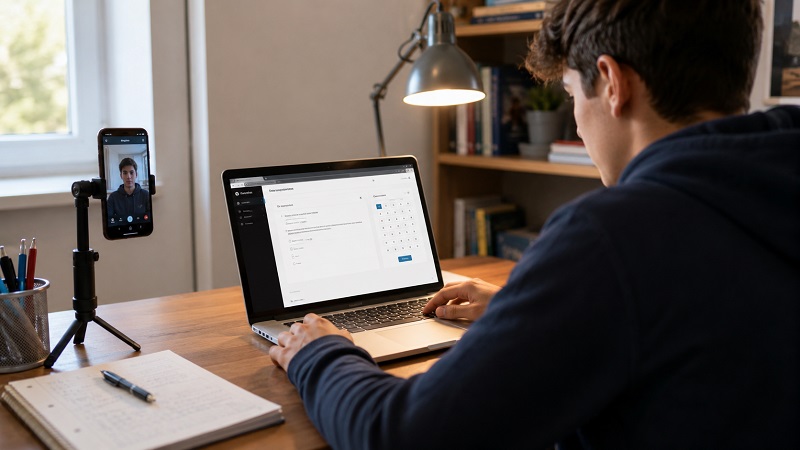
As education continues to move towards digital transformation, institutions across the world are searching for reliable ways to protect the integrity of online examinations. The shift to online learning has made education more accessible, but it has also introduced new risks that did not exist in traditional exam halls. To address these challenges, AI proctoring has emerged as one of the most powerful academic integrity tools available today.
AI proctoring is a technology driven method of supervising online examinations through artificial intelligence systems that analyse user behaviour, identify suspicious activity, verify student identity, and protect assessment authenticity. For colleges, universities, and professional certification bodies, AI proctoring provides an efficient and scalable solution to ensure fair and secure online exams.
This article explores the reasons why institutions need AI proctoring, how the technology works, the benefits it offers, and how it strengthens academic credibility in a rapidly changing education environment.
The Shift Towards Online Assessments
Educational institutions have embraced online learning due to its flexibility, cost savings, and accessibility. Students can now learn and complete assessments from any location using laptops or mobile devices. However, this convenience creates concerns about exam integrity. Without proper monitoring, institutions face risks such as:
- Impersonation
- Access to unauthorised materials
- Collusion between students
- Use of secondary devices
- Internet based resources being used unfairly
Traditional proctoring methods do not translate effectively into online environments. This is where AI proctoring becomes essential.
What is AI Proctoring
AI proctoring uses artificial intelligence to observe and analyse student behaviour throughout an online exam. Instead of relying on a human invigilator who watches dozens of students at the same time, AI uses automated systems that can detect irregularities with higher accuracy and consistency.
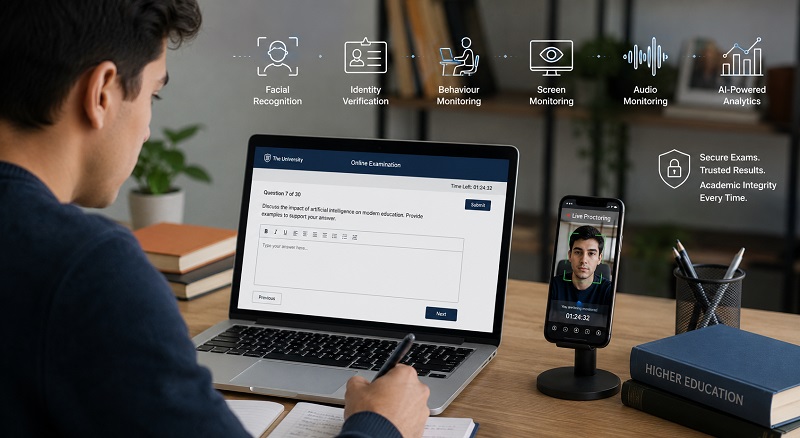
Typical AI proctoring features include:
- Facial recognition to verify identity
- Continuous face and movement detection
- Audio monitoring to detect unexpected voices or noise
- Screen analysis to track switching between applications
- Device monitoring to prevent the use of external tools
- Behaviour pattern recognition
AI does not replace human oversight completely. Instead, it provides a first layer of defence by flagging suspicious activity so that educators can review it after the exam.
Why Institutions Need AI Proctoring
1. Enhanced Exam Integrity
AI proctoring ensures that students are monitored consistently throughout the exam. Suspicious actions are flagged in real time, including repeated looking away from the screen, the presence of multiple voices, or attempting to minimise the exam window. This gives academic staff reliable evidence to review if misconduct is suspected.
2. Identity Verification
One of the most common challenges in online exams is confirming that the correct person is sitting for the assessment. AI identity checks use facial recognition and document comparison to confirm that the student matches institutional records. This prevents impersonation and maintains trust in examination outcomes.
3. Scalable Monitoring Solution
Traditional invigilators cannot supervise hundreds or thousands of online exam takers at once. AI proctoring can scale instantly, making it perfect for institutions with large enrolments. Whether one student or thirty thousand students sit for a test, AI can monitor them simultaneously without reducing accuracy.
4. Consistency and Accuracy
Human invigilators are prone to fatigue and human error. AI does not experience these limitations. It monitors every student with the same level of attention and remains active throughout the entire exam period. This ensures a fairer and more consistent examination environment.
5. Reduced Operational Costs
Institutions spend significant resources organising physical exam venues, paying invigilators, printing materials, and arranging logistics. AI proctoring reduces these costs by eliminating the need for many in person processes. Exams can be delivered remotely with fewer staff and minimal administrative planning.
6. Accessibility for Remote and Distance Learners
Students in rural or remote areas often face challenges accessing traditional exam centres. AI proctoring allows them to complete secure online exams from their homes or community centres without compromising integrity. This supports inclusive education and broadens institutional reach.
7. Digital Records for Auditing and Review
Most AI proctoring systems store video recordings, behaviour logs, screenshots, and audio files as evidence. These digital records assist with:
- Academic appeals
- Quality assurance
- Instructor review
- Validation of exam results
This level of documentation is impossible with manual invigilation.
8. Compliance with Accreditation Standards
Accreditation bodies increasingly expect institutions to show strong academic integrity measures. AI proctoring helps institutions meet these requirements by providing verified, secure, and traceable examination processes. Using AI proctoring also strengthens trust among external stakeholders, employers, and partner organisations.
How AI Proctoring Works
AI proctoring typically involves three major phases: pre exam checks, live exam monitoring, and post exam analysis.
Pre Exam Checks
Students must verify their identity before the exam begins. This may include:
- Taking a facial recognition photo
- Displaying an identity document
- Recording a short video for voice and behaviour matching
- Performing device compatibility tests
These checks ensure that each student can be authenticated.
Live Exam Monitoring
During the exam, AI uses the student’s webcam and microphone to analyse their behaviour. It identifies:
- Movements suggesting the use of notes
- Turning to speak with others
- The presence of another person in the room
- Attempts to open new browser tabs
- The use of secondary devices
All activity is recorded and scored for risk level.
Post Exam Review
After the exam, AI generates a detailed report that includes:
- Risk scores
- Behaviour flags
- Time stamped evidence
- Video recording
- Screen capture logs
Educators review these results to validate the exam and investigate flagged behaviour.
The Role of AI Proctoring in Academic Integrity
Academic integrity is the foundation of credible education. Institutions that allow unchecked cheating risk:
- Damaged reputation
- Loss of trust from employers
- Lower accreditation scores
- Unfair advantages for dishonest students
AI proctoring protects the value of qualifications by ensuring that exams reflect genuine performance.
Benefits for Educators and Administrative Teams
- Less manual supervision
- Simplified exam setup
- Automated identity verification
- Immediate flagging of irregularities
- Easy access to data driven insights
- Reduced workload during exam seasons
AI proctoring supports teachers by providing secure exam solutions that allow them to focus more on teaching and less on administrative tasks.
Benefits for Students
Many students welcome AI proctoring because it allows them to take exams in comfortable, familiar environments without travelling long distances or dealing with exam centre pressures. When applied fairly and clearly, AI proctoring promotes a level playing field for all candidates.
Challenges Institutions Must Address
Although AI proctoring provides multiple benefits, institutions should be aware of concerns such as:
- Student privacy
- Anxiety about being monitored
- Technical issues with webcams and microphones
- Varying internet speeds
These concerns can be addressed by using platforms with low data requirements, strong privacy protections, and offline or low connectivity exam support.
AI proctoring is no longer an optional add on. It is an essential tool for institutions looking to deliver secure online exams in a digital learning environment. With features such as identity verification, continuous monitoring, behaviour analysis, and detailed reporting, AI proctoring ensures academic integrity on a scale that traditional methods cannot achieve.
Institutions that adopt AI driven exam security now will be better prepared for future education trends and more trusted by students, accreditation bodies, and employers.
If your institution wants a dependable method to secure online examinations and strengthen student confidence, AI proctoring offers the ideal solution. To explore how this can be implemented in your organisation, visit our Contact page and connect with our specialist team today.
FAQs and Answers
1. What is AI proctoring in online exams
AI proctoring is a technology that monitors students during online exams using artificial intelligence to detect suspicious behaviour and ensure exam integrity.
2. How does AI proctoring help secure online exams
It verifies identity, observes behaviour, detects cheating attempts, and flags irregular actions, helping institutions maintain fair exams.
3. Is AI proctoring safe for students
Yes. Reputable platforms follow privacy laws, encrypt data, and store information securely while monitoring only what is necessary.
4. Can AI proctoring detect cheating
AI can identify unusual behaviour such as looking away repeatedly, talking, the presence of others, or switching applications during an exam.
5. Do students need special equipment for AI proctoring
Most systems require only a laptop or mobile device with a camera, microphone, and internet connection. No specialised hardware is needed.
6. Does AI replace human invigilators
AI does not fully replace humans. It provides automated monitoring while humans review flagged behaviour for final judgment.
7. Is AI proctoring suitable for large institutions
Yes. AI proctoring can scale to monitor thousands of students at once, making it ideal for universities and professional exams.
8. How can institutions start using AI proctoring
They can adopt a secure exam platform, run pilot exams, train staff and students, and gradually integrate AI proctoring into their assessment policies.